
 By Admin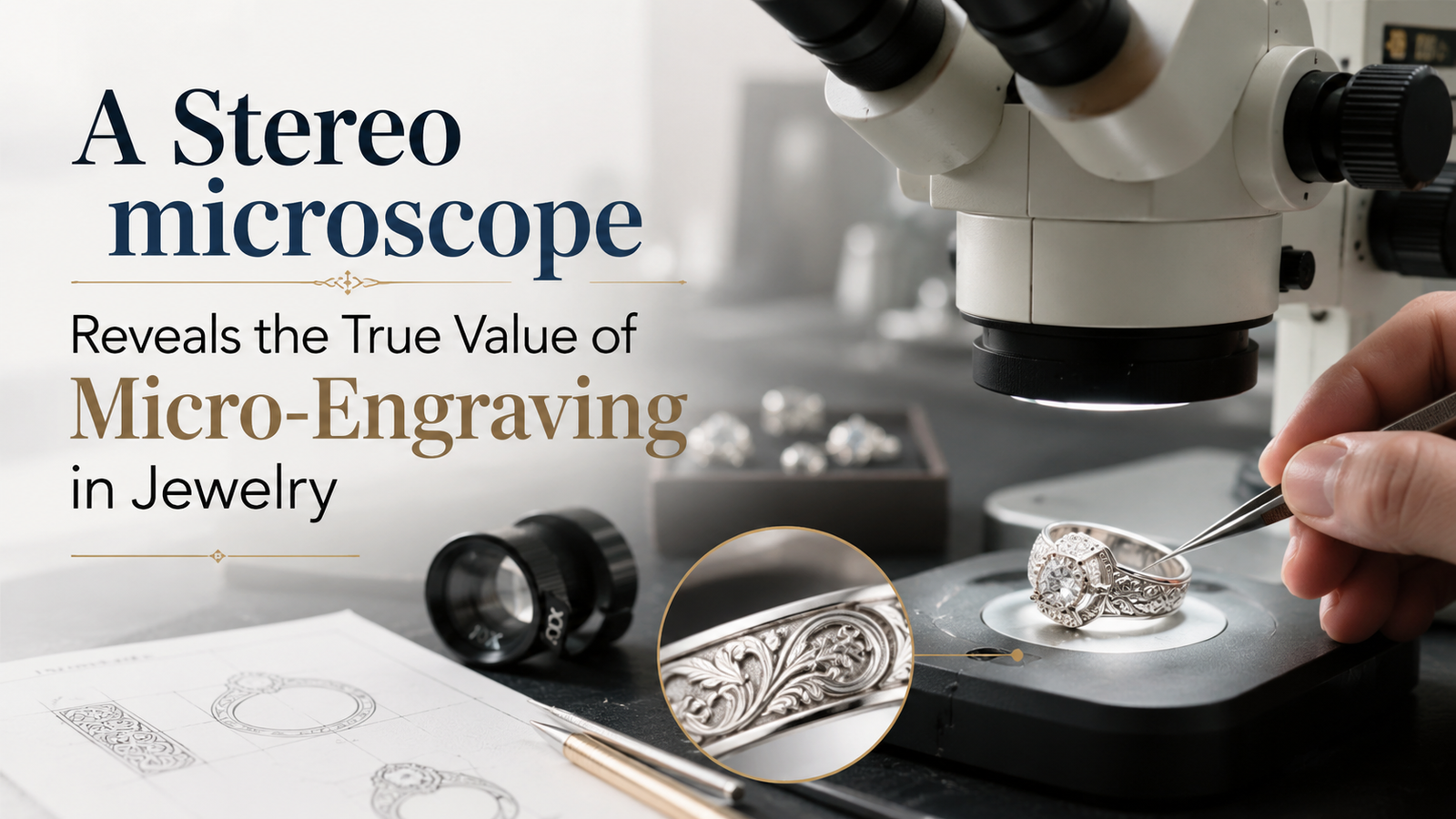
When a piece of micro-engraved jewelry dazzles with breathtaking beauty in a display case, onlookers often attribute it to the artisan’s almost innate “touch,” yet rarely ask: How are those relief patterns finer than a strand of hair and depth variations precise to the micrometer so masterfully controlled within such a tiny space?
The secret behind the art of jewelry micro-carving lies within that quiet high-definition stereo microscope resting on the workbench. It is not merely a magnifying tool, but a fundamental shift in creative logic—transforming every stroke of the carving tool from “feeling one’s way by touch” to “visualized, precise intervention,” ensuring even the finest lines on hard metal flow with effortless grace. This is the true, irreplaceable value of the high-definition stereo microscope.
The most difficult aspect of jewelry micro-carving has never been the “carving” itself
When most people think of micro-carving as a craft, they believe the greatest challenge lies in the steadiness of the artisan’s hand.
This isn’t wrong, but it’s only half the story.
In reality, the true challenge lies in making precise judgments within an extremely confined space.
Especially since jewelry pieces are inherently small—rings, pendants, and earrings leave the artisan with a workspace smaller than a fingernail.
Not to mention that people now increasingly favor intricate designs—feathers, petal textures, vintage carvings, or hidden engravings. With such minute details, even the slightest deviation can result in a less-than-satisfactory finish, making the piece appear less refined.
And at this scale, the human eye is actually very prone to error.
Especially after working for long periods.
Many jewelry artisans have had similar experiences:
Toward the end of a project, their vision starts to blur.
They’re convinced they’ve smoothed everything out, only to find fine lines still visible under magnification.
Sometimes it isn’t even a technical issue.
It’s simply because the human eye has its limits.
This is why more and more jewelry studios are turning to 3D printing.
After all, micro-carving is a craft that already operates beyond the range of comfortable human vision.
Some sense of “luxury” only truly comes into its own under magnification.
Many consumers today will say:
“This piece of jewelry looks exquisite.”
But if you ask them to define what “exquisite” means, most would struggle to articulate it—it’s hard to describe in concrete terms.
Upon closer inspection, some jewelry pieces aren’t complex at all; in fact, they appear quite simple at first glance. Yet they still convey a sense of refined delicacy.
It wasn’t until I gained more experience that I realized much of that sense of sophistication comes from the edge finishing.
For example, whether the transitions at corners and curves are sufficiently smooth, whether the patterns look natural, whether the depth of the engraving is uniform, whether there are any rough, jagged edges hidden on the surface, and whether the junctions between patterns appear abrupt.
These details might not immediately catch your eye at a normal viewing distance.
But people sense them subconsciously.
Plus, smartphone cameras are getting higher and higher resolution.
Many consumers have gotten into the habit of zooming in on details when buying jewelry.
Minor flaws that used to go unnoticed are now easily exposed.
In a way, a stereoscopic microscope is like a ticket to the refined world of sophistication.
The greatest value of a stereo microscope lies in its three-dimensional view.
When many people first hear about stereo microscopes, they immediately label them as simply “magnifying devices.”
But it’s only after using one for a while that they realize the true key to this instrument is its three-dimensional field of view with depth perception.
Take jewelry micro-carving, for example: where to place the tip of the tool, and which layers to leave or remove when trimming the edges—all depend on your precise sense of depth.
With ordinary flat magnification, it’s easy to misjudge—highs, lows, and depths all get flattened into a single plane. But a stereo microscope presents the entire workpiece in its true three-dimensional state. At a glance, you can tell exactly where something protrudes, where you need to shave off a few more layers, and where you’ve nearly over-polished.
That sensation is hard to put into words. If I had to draw a comparison, it’s a bit like working in fog before, and now finally turning on the light.
This is especially true for complex relief carvings with layer upon layer of detail—without this vivid three-dimensional view, they’d be virtually impossible to execute. After all, the undulations and interplay of forms are the very soul of the micro-carving craft.
In true professional micro-carving, much of the time is spent “refining the details.”
Most outsiders assume that the most mentally taxing part of jewelry making is the design and drafting stage.
But once you really dive into the world of high-end micro-carving, you realize that the most grueling part is actually the final refinement—especially when refining the edges. It’s not uncommon to spend ages going back and forth just to get the perfect balance of softness and sharpness in the curve of a single tiny corner.
The defining characteristic of micro-carving is that it must remain exquisite even when magnified.
That’s incredibly difficult.
Many pieces look fine at a normal viewing distance, but when magnified, the details collapse. Yet truly high-end micro-carved jewelry has the ability to remain flawless no matter how close you get.
This is where the stereo microscope proves particularly valuable. It allows the artisan to identify hidden issues during the shaping process, rather than discovering them only after the piece is complete and requiring rework.
Some tools don’t directly enhance aesthetics, but they do raise the bar for craftsmanship
I gradually came to realize that one unique aspect of the stereo microscope is this:
It doesn’t design the jewelry for you.
Nor does it instantly make the piece more sophisticated.
But it does transform your perception of “detail.”
And that is precisely where the deepest value of a high-definition stereo microscope lies.