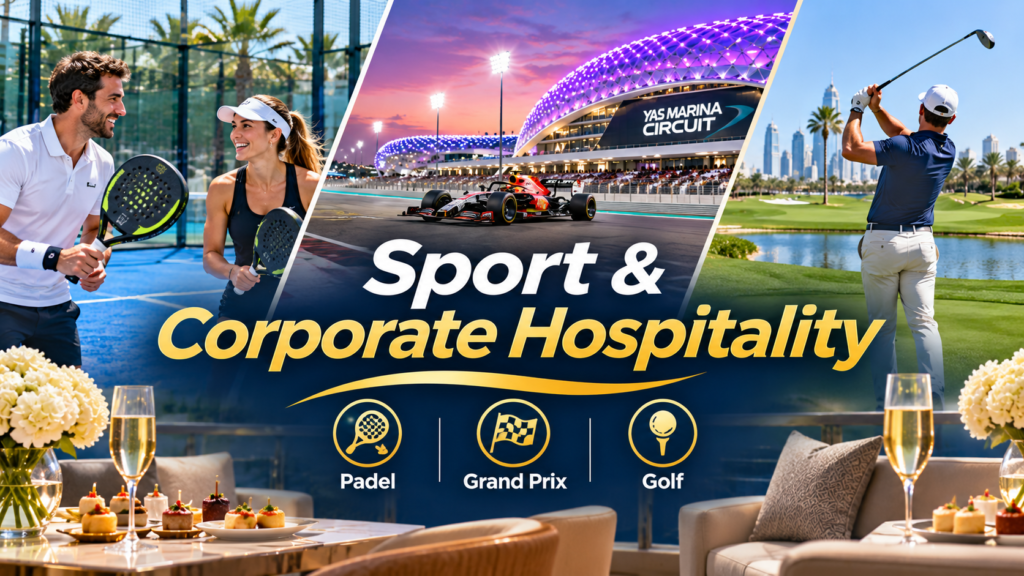
Corporate incentive travel has quietly become one of the most effective ways to build client relationships, and sport is usually at the centre of it. A shared experience does something a meeting room cannot: it gives people a memory in common, and that memory changes the tone of every conversation that follows. Whether the setting is a padel court, a golf course or a Grand Prix circuit, the principle is the same. People remember how a day felt long after they forget what was said in it.
This is not a new idea, but it has sharpened. Clients are offered more hospitality than ever, and the generic versions blur together. A day built around sport stands out because it asks something of guests, either to play, to watch with attention, or simply to be somewhere out of the ordinary. The companies that do it well treat the event as the start of a relationship, not as the reward for one.
Why sport took over the client dinner
The client dinner has a structural problem: everyone sits in the same seats, the conversation follows the same grooves, and the evening ends when the plates are cleared. Sport breaks that pattern. A morning on court or a day at a circuit gives people something to do together, and doing things together builds familiarity faster than sitting opposite each other. The conversation that matters often happens in the gaps, walking between holes, waiting for a session, or over a drink afterwards.
Sport also levels the room in a useful way. Job titles matter less when everyone is learning a new game or watching the same overtake, and that informality is exactly what hosts want. It is worth saying plainly that this only works when the sporting element is genuine. Guests can tell when an event is a sales pitch with a backdrop, and they respond accordingly. The sport has to be the point, not the decoration.
How corporate incentive travel is actually structured
A well-run incentive trip has a simple shape. There is a headline moment, the match, the race, the round, and around it a frame of travel, accommodation, meals and downtime that lets the headline breathe. Transfers are planned so guests never wait without a reason. The schedule leaves gaps rather than filling every hour, because the unplanned conversations are often the valuable ones. Companies planning a trip of this kind can start by looking at GP Management’s corporate events for how a hosted programme is put together for groups of different sizes.
Group size shapes everything. A group of eight can move quickly, eat together, and share a single experience. A group of forty needs structure: staggered arrivals, hosted tables, and a clear running order. The best trips also plan for the people who are not fans of the sport itself. Partners, colleagues and clients who come for the company need a reason to enjoy the day that does not depend on following the score.
Padel, golf and motorsport: three different tools
Padel is the most social of the three. The court is enclosed, the game is quick to pick up, and doubles play keeps everyone involved. It suits mixed-ability groups and guests who have never held a racket, because a beginner can rally within an hour and the atmosphere stays light. A padel morning followed by lunch is a compact format that works for a half-day event without asking too much of anyone’s diary.
Golf is slower and more conversational. A round gives four people several hours together, which is either a gift or a risk depending on the group, and it suits established relationships where the point is time rather than novelty. Motorsport is the spectacle of the three: scale, noise, speed, and a setting that feels like an occasion from the moment guests arrive. It suits milestone moments, larger groups, and clients you want to impress without asking them to perform.
What makes it work, and what ruins it
What makes it work is attention to comfort. Shade, water, good food, working transfers, and a host who knows the running order and stays visible without hovering. Guests should never have to ask what happens next, and they should never be left standing around without a reason. The details that matter are almost always logistical, not glamorous, and they are what separate a smooth day from a frustrating one.
What ruins it is overscheduling. A day packed with activity leaves no room for the conversations the trip exists to create. The other common mistake is the hard sell: a presentation shoehorned into the middle of a social day, or a host who steers every conversation back to business. Guests remember that, and not fondly. The trip should feel like a gift with no strings, because the return comes later, in trust.
Picking the right event for your clients
Start with the guests, not the event. How well do you know them? What do they enjoy? How much time can they give, and how far will they travel? A new relationship might suit a half-day padel event close to home. A long-standing client might warrant a Grand Prix weekend. Budget matters, but fit matters more: an expensive event that suits nobody in the group is worse than a modest one that suits everyone.
The final test is simple. Would your guests describe the day to someone else afterwards, and would they describe it warmly? If the answer is yes, the event has done its job. Sport earns a kind of attention that meetings and dinners rarely get, and that attention, spent well, is what turns a client into a long-term partner.