
 By Admin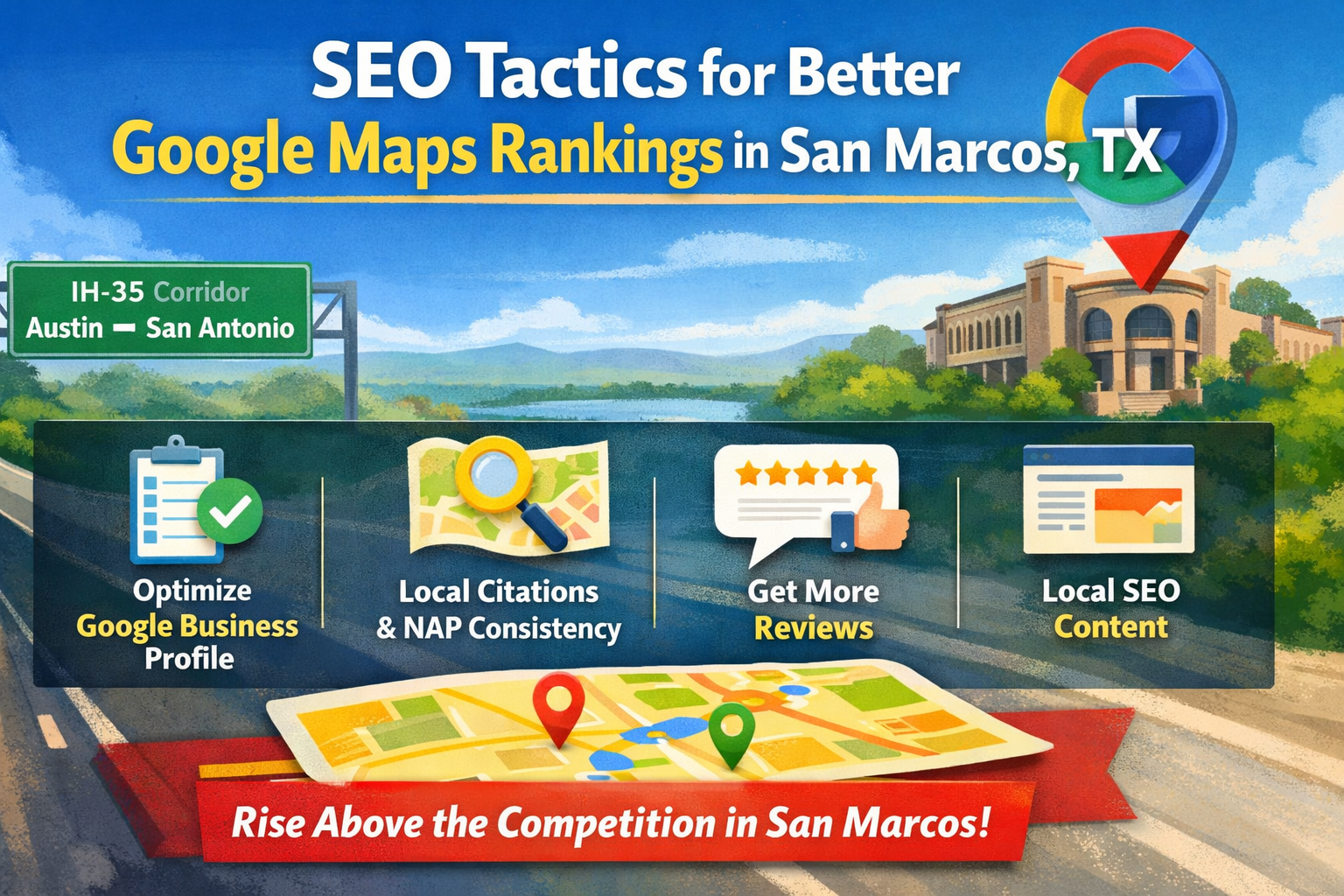
San Marcos sits right between Austin and San Antonio on the IH-35 corridor, which means local businesses here face competitive pressure from two major metro markets while still serving a distinct local community. Texas State University brings a large, rotating population. The city’s steady growth has made it harder to stand out in local search, especially on Google Maps where the top three results capture most of the clicks.
That’s why businesses working with a team that we design in San Marcos, TX know that showing up in local search isn’t an accident. It’s the result of deliberate, ongoing optimization across multiple channels. If you’re curious about the factors that significantly influence Google Maps rankings in a market such as San Marcos, the data provides the answers.
How Does Google Decide Which Businesses Appear in the Local Pack?
Before diving into tactics, it helps to understand how Google’s local algorithm actually works. According to Google, three core factors determine local pack rankings:
- Relevance: How well your Google Business Profile matches what someone searched for. If your profile doesn’t clearly reflect your services, Google won’t show you for those queries.
- Distance: How close your business is to the searcher or to the location mentioned in the search. You can’t change your address, but you can define your service areas accurately.
- Prominence: How well-known and trusted your business appears based on reviews, citations, backlinks, and overall online presence.
Understanding these three factors shapes everything else. Every tactic worth pursuing ties back to improving at least one of them, such as enhancing your online reviews, increasing citations, or building quality backlinks.
What Should You Do With Your Google Business Profile?
Your Google Business Profile (GBP) is the foundation of your local map presence. Research from a local pack ranking guide published in early 2026 found that a complete profile is up to 70 percent more likely to attract visits and leads than an incomplete one. That’s a meaningful gap, and it’s a free fix.
Fill Out Every Section Completely
This means your business name, address, phone number, website, hours, service areas, categories, and a description that includes location-specific language. Don’t just write a generic company blurb. Mention San Marcos. Reference the services you offer locally. Incorporate the terms that your customers commonly search for.
Choose Your Primary Category Carefully
Your primary category is one of the strongest relevance signals in the entire ranking system. A business that lists itself as a “marketing agency” when it primarily does web design is leaving relevance signals on the table. Be specific and accurate.
Post Regularly to Signal Activity
Google treats GBP (Google Business Profile) posts the way it treats fresh content on websites: as a signal that your business is active and engaged. Weekly posts about offers, local events, or industry tips all contribute to what search experts in 2026 describe as “freshness signals” that support higher visibility over time.
Why Does NAP Consistency Affect Google Maps Rankings?
NAP stands for Name, Address, and Phone number, which are essential details for your business listings. The way these appear across your website, your GBP, Yelp, Apple Maps, industry directories, and anywhere else your business is listed must be identical. Not close. Identical.
Even a small variation like “St.” versus “Street” or a different phone number format can send conflicting signals to Google. When Google can’t confidently verify your business details, it’s less likely to display your listing prominently. This consistency issue affects a surprising number of businesses, especially those that have moved, changed phone numbers, or rebranded at any point.
Please ensure to review your citations regularly. The big data aggregators like Data Axle and Foursquare feed information to dozens of smaller directories, so fixing data at the source often cascades downstream.
How Do Reviews Actually Influence Google Maps Rankings?
Reviews affect your prominence score directly. But the impact goes beyond star ratings. Research on Google Maps ranking behavior shows that reviews containing specific service keywords, like “best landscaping in San Marcos” or “fixed my AC same day in Martindale,” help Google associate your listing with those search terms.
The implication for businesses: don’t just ask customers to leave a review. Ask them to share a few words about the specific service they received. A prompt like “We’d love to hear what you thought about your experience with our [service name]” tends to generate more keyword-rich reviews than a generic ask.
Responding to every review, positive or negative, also sends engagement signals to Google and builds the kind of visible trust that turns map views into phone calls.
Does Your Website Support Your Google Maps Presence?
Your website and your GBP aren’t separate assets. They work together. A well-optimized GBP pointing to a thin, slow, or poorly structured website limits how far your local rankings can go.
Specific website elements that support Google Maps visibility include:
- Dedicated location pages for each city or area you serve, with content that addresses local search intent
- LocalBusiness schema markup that gives Google structured data about your business, address, and services
- Embedded Google Map on your contact page, which reinforces your location data and strengthens local relevance signals
- Fast mobile performance, since most local searches happen on phones and Google indexes the mobile version of your site first
A dedicated local page with content specific to the San Marcos market often makes the difference for businesses competing with both Austin and San Antonio, determining whether they appear in the local pack or get buried below it.
What Does Getting into the Google Maps Top 3 Actually Require?
There’s no single hack. Ranking in the San Marcos local pack requires consistent execution across several fronts at once: a complete and active Google Business Profile (GBP), accurate citations across directories, a steady stream of genuine reviews, a website that backs up your local presence, and location-specific content that tells Google exactly where you operate and what you do.
Businesses that neglect their Google Business Profile, treating it as a static listing, are losing out on potential revenue. Local search in San Marcos is competitive enough that the businesses willing to maintain their profile actively, earn reviews consistently, and keep their web presence aligned are the ones that dominate the map results month after month.
Frequently Asked Questions
What are the three main Google Maps ranking factors?
Google ranks local businesses based on relevance (how well your profile matches the search query), distance (proximity to the searcher), and prominence (your reputation based on reviews, citations, and online authority). Improving all three together produces the strongest results.
Could you please let me know how long it typically takes to achieve a higher ranking on Google Maps?
Most businesses see meaningful improvements within 8 to 12 weeks of consistent optimization, though competitive markets like San Marcos may require more sustained effort. Building review volume, fixing citation inconsistencies, and adding local landing pages all contribute to faster results.
Do Google reviews help with local rankings?
Yes. Reviews are a key component of the prominence signal Google uses to rank local businesses. Reviews that contain service-specific keywords also help with relevance. Responding to reviews consistently signals active engagement and builds trust with both Google and potential customers.
What is NAP consistency and why does it matter?
NAP stands for Name, Address, and Phone number. Keeping this information identical across all online directories, your website, and your Google Business Profile helps Google verify your business details with confidence. Inconsistencies can dilute ranking power and cause your listing to appear lower in local results.
Should a business in San Marcos have a separate landing page for local SEO?
Yes. A dedicated landing page for San Marcos, with content tailored to local search intent, strengthens the connection between your website and your Google Business Profile. It also helps rank for location-specific queries that broader service pages won’t target effectively, thereby improving visibility in local search results and enhancing overall search engine optimization (SEO) efforts.
What is a Google Business Profile post, and does it help rankings?
GBP posts are short updates (such as offers, events, and business news) that appear in your Knowledge Panel, which is the information box that shows up on the right side of Google Search results. While posts may not directly boost map rankings on their own, they increase engagement and click-through rates and signal to Google that your profile is active and maintained.
What is the LocalBusiness schema, and why does it matter for local SEO?
LocalBusiness schema is structured data markup added to your website that tells search engines precise details about your business: name, address, phone, hours, and service areas. This makes it easier for Google to match your website with your GBP and surface your business in relevant local searches.
Can a slow website hurt Google Maps rankings?
Indirectly, yes. While Google Maps rankings rely primarily on GBP signals, your website’s performance affects the overall trust and authority signals Google associates with your business. A slow or mobile-unfriendly site can also hurt the organic listings that appear alongside your map listing, potentially leading to decreased visibility and traffic for your business online.